
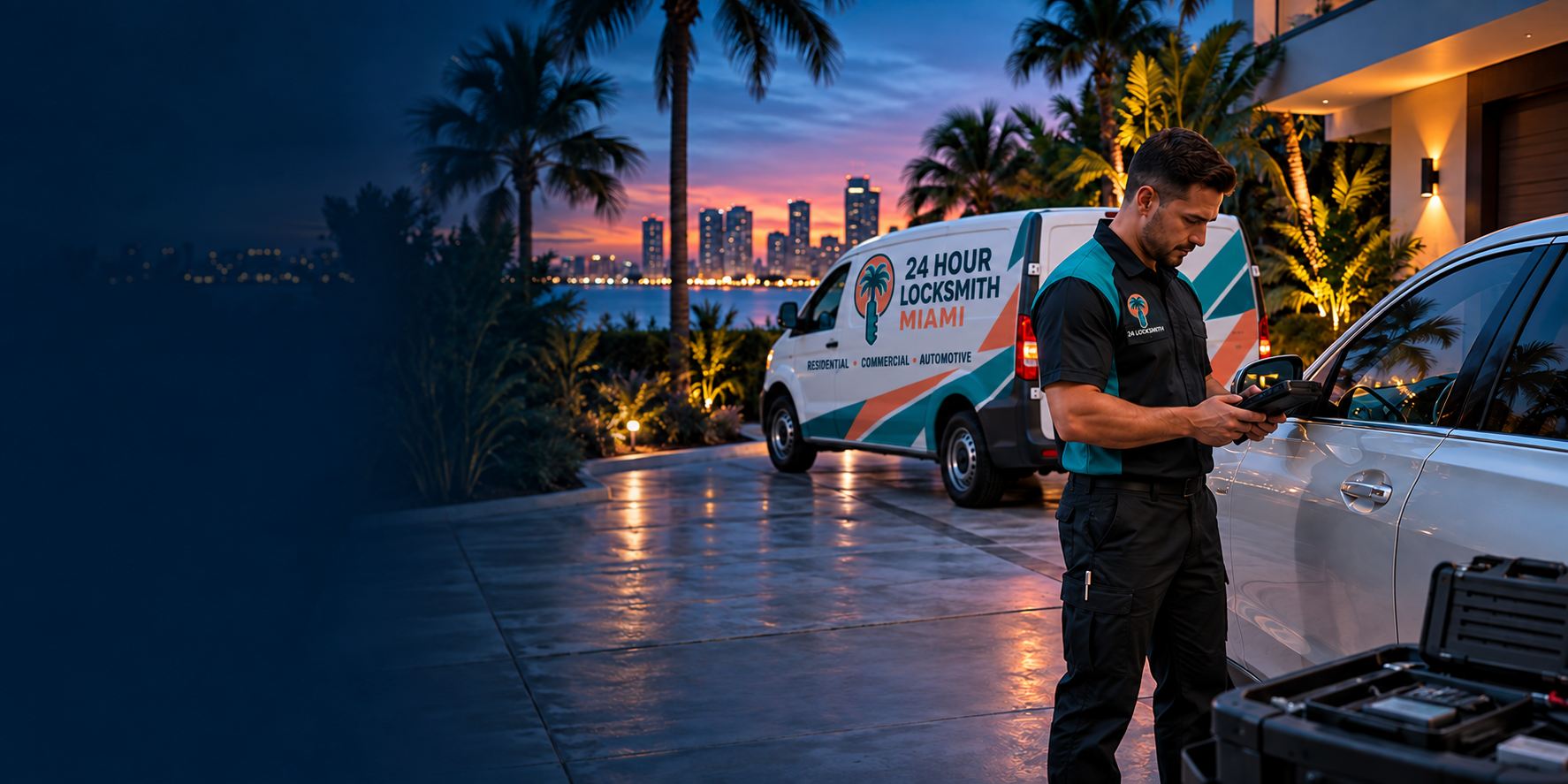
Three lanes, one set of ground rules
Locksmith calls in Miami-Dade fall into three lanes. The first is the home: a front door that will not turn, a sliding door that drags, a set of keys that vanished after a move. The second is the business: a storefront, an office suite, a warehouse bay, a property manager with forty doors and a stack of old keys. The third is the vehicle: a car that will not recognize its key, a fob with a dead battery, an ignition that has gone stiff. Each lane has its own tools and its own vocabulary, and this site gives each one a full section of guides.
The ground rules are the same everywhere. A reputable locksmith confirms who you are in relation to the property before touching a lock. Quotes come by phone, after you describe the job. Any service call charge is explained before a technician is dispatched, so nothing is a surprise at the door. And nobody should promise an exact arrival time, because traffic on the Dolphin Expressway, a bridge opening on the Miami River, or a summer storm cell can change any trip. Those rules protect you, and they protect the technician too.
If you want the short version of how the three lanes are organized, start at the residential hub, the commercial hub or the automotive hub. If you are standing outside a locked door right now, the emergency hub is built for that moment, and the guide to how a locksmith call works takes about five minutes to read while you wait.
The brand name says 24-hour because round-the-clock help is the idea behind the service. It is a concept, not a promise that a person will be standing at every address at every hour. When you call, you will be told what is realistic for your location and your situation.
Authorization comes first, every time
Before any lock is opened, rekeyed or replaced, a locksmith needs to know that you have the right to ask. That is not red tape. A locksmith who opens doors for anyone with a story is a tool for burglars and for people in the middle of a property dispute. A professional will ask for proof, and a good caller is relieved to hear the question.
For a home, proof of ownership or authority usually means a photo ID that shows the address, a lease in your name, a utility bill, or a mortgage or closing document. A tenant can authorize work on the door they rent, but changing the lock on a rental can be a lease issue, which is why the guide on renter lock changes exists. For a business, it means being the owner, a manager on record, or an agent for the property owner, covered in commercial authorization. For a vehicle, it means a registration or title that matches your identification, explained in the car key ownership proof page.
Two reference guides carry the details. Authorization needed before locksmith work walks through who counts as an authorized person in different situations, including family members, roommates, property managers and house sitters. What ID to have ready gives a practical checklist so the call goes quickly.
What if you are locked out and your wallet is on the other side of the door? That is a common problem, and it has honest solutions: a neighbor who knows you, a building manager with records, a mail piece or document kept in a car, or a person who can bring ID to the site. A locksmith who skips verification because you are in a hurry is not doing you a favor.
What the home lane covers
Residential work in Miami-Dade is shaped by the housing stock. Older concrete block homes in Hialeah and Miami Springs often have original door hardware that has been rekeyed or painted over many times. Mediterranean-style houses in Coral Gables have heavy wooden doors and decorative hardware that deserve careful handling. Condos along Brickell and Miami Beach have fire-rated entry doors with building rules about what can be changed. Suburban homes in Kendall and Pinecrest lean toward standard deadbolts, sliding patio doors and garage entry doors.
The most common calls are a residential lockout, a rekey after moving in, a deadbolt replacement, and a broken key in a lock. Next come the quieter jobs: a sticking lock cylinder that gets worse each month, a sliding glass door lock that no longer latches, or a weak strike plate that lets a door flex under a shoulder.
Newer technology has its own category. Smart lock installation and keypad lock setup are popular with short-term rental hosts, families with teenagers, and people who are tired of key hunting. These locks bring their own questions about batteries, door prep and what happens in a power outage, and the guides explain them without selling anything.
Life events drive many calls. Locks after a separation, repair after a break-in and lost house keys are situations where people are stressed and need clear steps. The full list lives on the residential hub.
What the business lane covers
Commercial locksmith work is less about a single door and more about a system. Who holds keys? Which doors share a keyway? What happens when an employee leaves? A small shop on Calle Ocho and a distribution unit in Doral both need answers to those questions, but the scale and the hardware are different.
Daily jobs start with storefront lock repair, commercial rekeying and office lockouts after hours. Bigger planning jobs include master key systems, restricted keyways that stop casual copying, and small business access control with cards or fobs replacing metal keys.
Hardware that interacts with life safety needs extra care. Panic bar and exit device repair and magnetic lock basics are written to help you understand the questions to raise with a qualified professional and the local fire authority, not to replace them. A door that must open in an emergency is never a place to experiment.
Property managers and associations have their own pages. Lock turnover between tenants, multifamily key systems and association locks cover the record keeping that keeps a building manageable. Restaurants, medical offices, hotels and schools each have a page too, because a walk-in cooler door and a pharmacy storage door are not the same problem. The commercial hub lists them all.
Commercial customers should also read the commercial lock audit page, which describes how a walk-through of your doors can reveal worn hardware and forgotten keys before they become an after-hours emergency.
What the vehicle lane covers
Car key work has changed more than any other part of the trade. A metal blade cut at a hardware counter used to be enough. Today most keys carry a transponder chip, and many cars use a smart key that talks to the vehicle by radio. Programming equipment, the right blank and a clear ownership trail matter more than the cutting machine.
The foundation pages are all keys lost, spare key programming, transponder keys and smart key fob replacement. If a fob works poorly rather than not at all, see fob battery and reprogramming, since a simple battery problem is sometimes mistaken for a failed fob.
Mechanical trouble is covered too. A broken key in the ignition, a worn ignition cylinder or a steering wheel lock that is stuck are repairs where the first rule is not to force anything. Brand pages such as Toyota, Honda and BMW and Mercedes explain what is typical for each make, without promising that your exact model is covered until you describe it by phone.
Two comparison pages help with decisions: dealer or locksmith and duplication versus cloning. Fleet owners and tradespeople with vans can go to fleet key management. Everything is gathered on the automotive hub.
One safety point belongs here. If a child or a pet is locked in a car, the situation is urgent and the advice is to call 911 first. See child locked in car for what to say and what to do while help is on the way.
Where the service reaches in Miami-Dade
Miami-Dade is a big county with very different neighborhoods, and a lock problem in one is rarely the same as in another. The service areas hub has a page for each major area, and the county service area overview explains how coverage works and why the answer for your address always comes from the phone call, not from a map.
In the urban core, Brickell and Aventura are about high-rise doors, building access rules and doorman or key-fob systems. On the barrier islands, Miami Beach, South Beach and Key Biscayne deal with salt air, short-term rentals and bridge traffic.
Inland and suburban pages include Coral Gables, Coconut Grove, Hialeah, Doral and Kendall. Doral is warehouse and office country, Hialeah is older block housing, and Kendall is mostly suburban single-family streets with a lot of garage entries.
To the south and north you will find Homestead and Florida City, Cutler Bay, North Miami and Miami Gardens. There are also pages for gated communities and waterfront homes, because a guard gate or a salt-water canal changes how a lock job works.
The way to learn whether a technician can reach you, and what is realistic, is the same everywhere: call, give the address and the situation, and listen to what you are told.
How a call works, step by step
A good locksmith call is calm and structured. You describe the problem: which door or vehicle, what has happened, whether anyone is inside, and whether a key is broken, lost or simply stuck. The person on the phone asks about the lock type, the make and year of a vehicle, and whether the situation is safe. The page on describing your lock problem gives phrases that make this faster, and photos that help a locksmith explains which pictures save time.
Next comes the quote. Quotes are given by phone only. The site does not list prices, because the right answer depends on the lock, the door, the vehicle and the situation, and a number on a web page would be a guess dressed as a fact. For simple jobs a phone quote may cover the whole task. For complicated jobs, such as a damaged frame, an old master key system or a vehicle with an unusual immobilizer, a technician may need to see the work on site before giving a final quote.
There is a service call charge for dispatching a technician. It is explained on the phone before anyone is sent, so you can decide with all the facts. The guide on service call charges and quotes explains what the charge is for, what to ask, and why a clear explanation is a good sign.
Arrival is handled honestly. No exact arrival time is promised, because distance, traffic, weather and the number of calls in the county all change the picture. What you can expect is a realistic conversation about your location. Once a technician arrives, verification happens again, with ID and proof of authority, before work starts.
If you are waiting, waiting safely and the emergency call checklist are useful reading. And after the work, the after-service checklist helps you confirm that every key works and every door latches.
Emergencies and what is safe to do
When something goes wrong at a door, the first question is whether anyone is in danger. A child or a pet shut inside a hot car, a person who needs medical help behind a locked door, a smell of gas or smoke: those are 911 situations, and a locksmith call comes second. The locked out with children inside and lockout with pets inside pages are written with that order in mind.
For ordinary lockouts, the safe advice is simple. Stay calm, stay in a visible and well-lit place, and do not try to force a door, break a window or climb a balcony. Those moves cause injuries and damage that cost far more than a locksmith visit. This site never teaches lock bypass or picking, and that is on purpose. Instructions that help you would help a burglar just as well.
Some situations are tied to Miami weather and daily life. Lockouts after a hurricane and lockouts during a power outage involve swollen doors, dead keypads and crowded roads. Night lockouts and parking lot lockouts involve personal safety as much as locks.
Security incidents need a different tone. After a theft or a burglary, see stolen keys, burglary aftermath and emergency lock change. Report the crime to the police first, then secure the door. If you are unsure whether someone has tampered with a lock, signs of lock tampering describes what to look at without touching the lock itself.
Browse everything on the emergency hub.
Avoiding scams and choosing a locksmith carefully
The locksmith trade has a reputation problem, mostly because of fake listings and call centers that route a call to whoever is available, quote a low phone number and then raise the amount at the door. The guides here are written to help you spot the pattern before it costs you. Start with how to verify a locksmith, which tells you what to look for and what to ask, and remember that no website can vouch for credentials on your behalf. You should always check them yourself.
Read scam warning signs and fake local listings and call centers before you search in a hurry. Then look at bait and switch tactics, drill-it-first warning signs and unmarked vehicle and no ID red flags. A competent technician usually tries non-destructive methods first and explains why before anything is damaged.
A short list of questions to put to any company is in questions to ask before hiring a locksmith. The core ones are these:
If something has already gone wrong, what to do after a bad locksmith experience covers record keeping and where complaints can go, and paying safely explains payment habits that protect you.
- Does the person on the phone state the business name clearly, and does it match what the technician shows at the door?
- Will you hear the service call charge and the method for quoting before a technician is dispatched?
- Will the technician ask for proof of ownership or authority, and carry identification of their own?
- Will they explain why a lock needs replacement instead of repair, and tell you what they plan to do before they do it?
Planning ahead: guides for owners and managers
Most locksmith visits happen under stress, but the best outcomes come from planning. The guides section is where to do that quiet thinking. Home security layers and doors that matter most in a home help you decide where a limited effort does the most good. Rekey or replace and repair or replace give you a framework for the decision that comes up on most calls.
Miami conditions deserve their own attention. Hurricane preparation for locks and doors and salt air and humidity lock wear explain why a lock near the water wears out differently from one inland, and why a quick spray of the wrong product can make things worse. For tall buildings, condo door hardware rules and apartment lock security basics are the right starting point.
Families, landlords and caregivers each have a page: key control for families, key control for landlords and elder care access planning. If you are moving, the move lock checklist keeps old keys from following the previous occupant around the city.
Owners of businesses can read securing a business after hours and access control planning. Everyone benefits from getting a second opinion before expensive lock work, which is a normal and sensible thing to do. The whole library sits on the guides hub.
What to have ready before you call
A little preparation shortens the call and reduces mistakes. Know the exact address, including the unit or suite number and any gate or building access instructions. Know which door or vehicle is involved. If a vehicle is the subject, have the make, model and year, and be ready to confirm the vehicle identification number from the dashboard or a document once you are authorized.
Gather proof of authority where you can: photo ID, a lease, a deed or closing document, a registration, a business registration, or a note from the owner if you act for them. The page on preparing for a lock visit adds practical items such as clearing space around the door and securing pets. For key programming jobs, what to expect during key programming explains the vehicle side, and what to expect during a rekey explains the home side.
Think about what you want from the visit. Do you only need to get in, or do you also want to change the lock because keys may be in the wrong hands? Do you want spare keys cut, or a plan for several doors? Larger plans are covered in planning a multi-door lock project. If a door cannot be repaired right away, temporary securing of a door until repair lists safe holding measures that do not damage the frame.
Finally, decide who will be present. A person with authority should be on site when work starts. If you are not able to be there, tell the dispatcher in advance, because that changes what verification is possible.
When you are ready, call, describe the job, ask your questions about the service call charge and quote, and make a decision with the facts in front of you. That is all this site asks of you, and it is what a reputable locksmith will expect.
Questions people ask
Do you list prices on this site?
No. Quotes are given only by phone, because the right answer depends on the lock, the door or vehicle, the condition of the hardware and the situation. Simple jobs can often be quoted on the call. More complicated jobs may need a technician to look at the work on site before a final quote is given.
What is a service call charge?
It is the charge for sending a technician to your location. It is separate from the work itself, and it is explained on the phone before anyone is dispatched, so you can decide whether to go ahead. If anything is unclear, ask for it to be repeated in plain terms before you agree.
Why am I asked for ID before a lock is opened?
A locksmith must be sure you have the right to ask for the work. Proof can be a photo ID with the address, a lease, a closing document or a registration for a vehicle. Anyone who skips this step for a stranger could just as easily help a burglar, so the question protects you as well.
Can you promise how soon a technician will arrive?
No honest locksmith can promise an exact arrival time. Distance, traffic, weather and how many calls are open across the county all change the trip. The dispatcher will talk with you about what is realistic for your address, and you can decide whether to wait or look for another option.
Will you explain how to get into a locked door myself?
No. This site never teaches lock bypass or picking, because the same steps work for people with bad intentions. It does explain what is safe to do while you wait, such as staying in a lit, visible place and gathering ID. If anyone is in danger inside, call 911 first.
Which areas of Miami-Dade do you help in?
The service area pages cover neighborhoods and cities from Aventura in the north to Homestead in the south, plus the beaches and islands. Whether a technician can reach your exact address, and what is realistic that day, is confirmed on the phone when you give the location.
Describe the situation by phone and we will tell you what the job involves. Quotes are given by phone. Jobs that cannot be quoted without seeing them need a technician on site, and the service call charge is explained on the phone before anyone is dispatched.
(786) 539-3980Related pages
Written by Claude (AI) (AI) for 24 Hour Locksmith Miami.