
First, your safety
If anyone is in danger, or if you believe someone is inside your home who should not be, step away from the door and call 911. A locksmith is not the right first call for a possible intruder, a medical emergency, a fire or a child or vulnerable person trapped inside in distress. Emergency services can force entry when a life is at risk, and that is their job. Everything below assumes the situation is an ordinary lockout: you are outside, the home is empty or everyone inside is fine, and the only problem is that you cannot get in.
Before you do anything else, look around. Are you in a well-lit spot? Is anyone nearby who makes you uneasy? If you feel unsafe where you are standing, move. A lockout is a problem that can wait a little. You can make the phone call from a lit store entrance, a neighbor's porch if you know them, a gas station or a lobby. You do not have to stay in front of your own door, especially if it is dark and the area is quiet.
Keep your phone charged and in your hand. If the battery is low, say so when you call so that the person on the other end can get the essential details quickly, and consider borrowing a charger from a nearby business or a friend. Tell someone you trust where you are and what is happening. A text to a family member or friend takes ten seconds and puts another set of eyes on the situation.
Think before you try anything yourself
It is natural to want to solve the problem at once. Many people look for an unlocked window, try to climb onto a balcony or pry at a door. At night, these attempts are more dangerous because visibility is poor, and they can damage the door, the frame or the window, turning a small problem into a larger one. A scraped hand or a fall from a ledge in the dark is a far bigger setback than waiting for a professional.
Do not try to force the lock, and do not look for instructions on bypassing it. A forced door can leave you with a damaged frame that cannot be secured for the night, which is a problem of its own. A careful technician can often restore access with less damage than an amateur attempt, and when something does have to be repaired, they can discuss it with you on site.
Instead, check the simple things first. Is there a spare key with a family member, a roommate or a neighbor you trust? Is there a property manager, a building superintendent or a concierge who holds a key? Is there a person inside the home who can come to the door? Try your phone for a smart lock app if your lock has one. Check whether a lockbox you set up for this purpose is nearby. If one of these works, you are done. If not, you are ready to call.
Where to wait safely
Choose a waiting spot with light, people and an easy exit. A well-lit storefront, a hotel or condominium lobby, a restaurant that is still open or a gas station are all better than a dark yard. If the building has a concierge or a security desk, they may be able to help directly, as we describe for tall buildings on our high-rise lockout page.
If you remain near your home, stay where you can see the street and where the street can see you. Avoid sitting in the dark behind a hedge or beside a fence. If a neighbor offers to let you wait inside, you can decide for yourself whether you are comfortable. If you accept, choose a neighbor you know, tell someone where you are, and keep your phone with you.
Rain, heat and mosquitoes are part of Miami nights for much of the year. If the weather is bad, shelter takes priority over standing next to the door. Our page on being locked out in a summer downpour covers getting dry safely while help is arranged. For more general guidance on waiting well, see safe waiting while a locksmith arrives.
- Lit areas with other people nearby.
- A lobby, open business or a trusted neighbor's porch.
- A spot where you can see the street and the street can see you.
- Shelter from rain and heat if the weather is bad.
- Never a dark corner, a gap in a hedge or the side of the building.
What to tell the dispatcher
Clear information at the start makes the rest of the call easier and helps the technician bring the right tools. Start with where you are. Give the street address, the building name if there is one, the unit number or floor, and any landmark that will help someone find you in the dark. If you are waiting somewhere other than the door, say where, and say how to reach you.
Describe the door and the lock. Is it a front door, a side door, a sliding glass door or a gate? Does it have a deadbolt, a knob lock, a keypad or a smart lock? Is it a single lock or several? Tell the dispatcher whether the door is simply shut and latched or whether the deadbolt was thrown, and whether you know if the door was locked from the inside or the outside. You do not need to be an expert. A plain description is enough, and photos are useful if you can take one safely.
Say whether you live there and whether the home is a house, a condo or an apartment. In a building with a management office, say so, since the technician may need to coordinate. Mention whether there are children, elderly relatives, pets or anyone medically vulnerable inside, because that affects how the call is handled. If anyone inside is in distress, tell them to call 911, and if you cannot reach them, call 911 yourself. Our page on locked out with children inside covers that situation specifically.
Proof that the home is yours
A responsible technician will ask you to show that you live at the address before opening the door. A lockout is one of the situations where this matters most, because anyone could claim to live in a house and ask for access. The step is for your protection, and you should be glad when it is asked.
Typically that means photo identification showing your name and, where possible, the address, or other documents that connect you to the home, such as a utility bill, a lease or mail. If you are a renter, the property manager may need to confirm. If your ID is inside the home, tell the dispatcher at the start. The technician will explain what other proof they can accept, and the options depend on the situation.
Having proof ready speeds up the visit and avoids an awkward pause on your doorstep. If you are not at the address but you are the owner or authorized, the technician may need confirmation from you or from someone who can speak for you. If you are not at the address but are the owner, expect the technician to want confirmation from you directly.
Verify who is on the way
Anyone can call themselves a locksmith, and at night, when you are anxious and rushed, a scam can look like a rescue. Take a few moments to check. When you call, ask for the name of the business and the technician, and ask how the technician will identify themselves when they arrive. Write down the business name and the phone number you called.
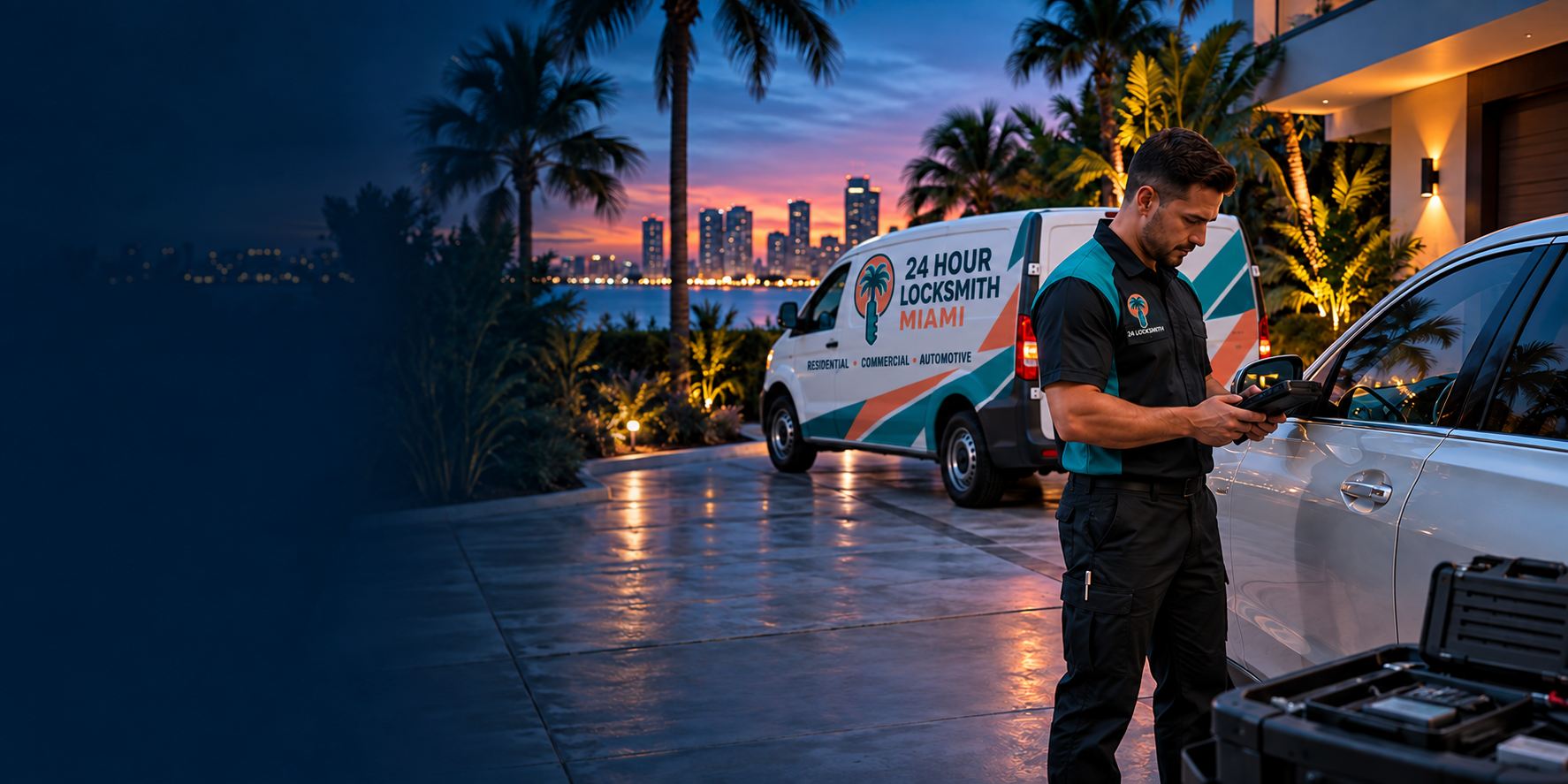
When the technician arrives, check that the vehicle and the person match what you were told. A reputable technician will show identification and will tell you who they work for without hesitation. Be cautious if the business name on the truck is different from the one you called, if the technician has no identification, or if the person seems to know nothing about your call. You can ask them to wait while you confirm by calling the number you used.
Before any work starts, expect the quote and the service call charge to be explained. Quotes are given by phone only, and a service call charge is explained before dispatch. If the technician introduces new charges on the doorstep, or starts to drill a lock without first explaining why, stop and ask. You are allowed to decline and to request an explanation. Our guide on locksmith scam warning signs lists what to look for.
What happens when the technician arrives
The technician will confirm who you are and that the home is yours, look at the door and the lock, and explain what they plan to do. Most home lockouts involve a standard lock, and the goal is to restore access with as little damage as possible. In some situations, such as a lock that has failed, a heavily reinforced door or a damaged frame, the approach is different, and the technician will tell you why.
You do not need to hover or help. It is fine to stand back and let the person work, and it is reasonable to ask questions. If the lock has to be replaced, the technician will explain the options, and any significant additional work will be quoted before it begins. Nothing should happen to your door that you have not been told about.
Once the door is open, test it. Check that the lock turns smoothly, that the door closes properly and that the key you have still works. If you have a smart lock or keypad, check that it responds. If the lock was damaged in the process, ask what that means for security overnight. A technician can often secure a door for the night, and if more work is needed, they can explain what to do and when.
Different homes, different nights
A lockout in a single-family house in Kendall or Hialeah is not the same as one in a townhome, a garden apartment or a duplex. A house usually means a front door with a deadbolt, a side or rear door and sometimes a sliding glass door onto a patio. You may have several ways to ask for help, such as a neighbor with a spare, but also several doors that may be locked. A townhome or duplex shares walls and sometimes entrances, and a neighbor may be able to confirm that you live there, which can make the proof step easier.
In a garden-style apartment complex, there may be an on-site office that closes in the evening and an after-hours maintenance number. In older block homes common in parts of Miami-Dade, doors and frames may be older and more worn, and the lock may behave differently from a newer one. In a newer home with a smart lock, the question might be as simple as a dead battery or a phone that is not connecting. Telling the dispatcher what kind of home you have helps them prepare.
Gated communities add a step: the technician may need to be admitted at the gate, and the guard may need your name or a call from you. If you are in a gated area, tell the dispatcher, and let the guard know to expect a visitor. Our page on gated community and guard gate locks goes into how that usually works.
Looking after people and pets while you wait
A lockout is an inconvenience when you are alone and a real worry when you are responsible for others. If you are with children, keep them close and keep them warm, dry and calm. Find a safe place to wait, such as a lobby or a trusted neighbor's home, and avoid leaving a child alone in a car or out of sight while you make the phone call. If a child or another person is inside the home alone and cannot open the door, tell them to stay calm and stay where they are, and call 911 if there is any sign of distress.
If a pet is inside, think about the heat. Miami nights can stay warm and humid, and an animal in a closed home with the air conditioning off for an extended period can become uncomfortable. Tell the dispatcher about the pet so the technician comes prepared, and tell a neighbor or friend who might be able to check. If you are worried about an animal in distress, call local animal services or 911 for guidance.
If someone in your household takes medication on a schedule, check whether they have what they need with them. A lockout that stretches on is a reason to think about arrangements, such as a friend who can host or a pharmacy that can provide a short supply. Do not let a wait stop you from getting care you need.
Making the door safe for the rest of the night
After a night lockout, you want to be sure the home is secure before you sleep. Walk through and check each entry point: the door you just used, any other exterior doors, windows and sliding doors. If something was left unlocked while you were out, lock it now.
If the lock was replaced or rekeyed, make sure you have every key you need and that anyone who lives with you has theirs. If a key was lost rather than locked inside, think about who might have found it. A rekey makes the lost key useless. Our page on lost house keys and what to do next explains the options and how to decide.
If the door or frame was damaged, ask the technician whether it can be secured temporarily. Ask the technician what safe, temporary measures are available until a repair can be done. If you do not feel safe in the home after a lockout, particularly if you suspect anyone has been inside, call 911 and leave the premises until the situation is checked.
Preventing the next late-night lockout
Most nighttime lockouts follow a pattern: someone steps out for a moment, a door locks behind them, and the keys are inside. A few habits reduce the chance. Keep a spare key with someone you trust, such as a family member or a neighbor. If you use a lockbox, place it where it is not obvious, and choose a combination that is not easy to guess. Do not hide a key under a mat or a flowerpot, which is the first place anyone would look.
Consider a keypad or smart lock that lets you enter without a key, or a deadbolt that stays unlocked until you actively lock it. These choices have trade-offs, such as battery upkeep, that are worth weighing. Check batteries on any electronic lock on a regular schedule.
When you are ready, call, tell the dispatcher where you are and what the situation is, and a technician will explain the next step, the quote and the service call charge before anyone is sent.
Questions people ask
Should I call 911 or a locksmith if I am locked out at night?
Call 911 first if anyone is in danger, if you think someone is inside who should not be, or if a child or vulnerable person is trapped in distress. For an ordinary lockout where everyone inside is fine, a locksmith is the right call. If you feel unsafe where you are standing, move to a lit public place before making the call.
What should I tell the dispatcher?
Give your exact location, including the street address, building name and unit, plus a landmark. Describe the door and the lock, say whether you live there, and mention anyone vulnerable inside. If you are waiting somewhere other than the door, say where. Having photo ID or proof of address ready speeds up the visit.
How do I know the person who shows up is the locksmith I called?
Ask for the business and technician names on the call. When the person arrives, check that the vehicle and identification match what you were told. Be cautious if the business name differs, if there is no identification, or if the person seems unaware of your call. You may ask them to wait while you confirm by phone.
Do I need to prove I live here?
Yes, a responsible technician will ask. Photo ID showing your name and ideally the address, or documents like a lease, utility bill or mail, are commonly used. If your ID is inside, say so on the call and the technician will explain what else they can accept. The step protects you from someone else gaining access.
Can I try to get in through a window or balcony?
It is not recommended. At night, falls and cuts are more likely, and you can damage the window or frame, leaving the home harder to secure. A technician can usually restore access with less damage. If someone inside is in danger, call 911 instead of attempting entry yourself.
How are charges handled at night?
Quotes are given by phone only, and a service call charge applies and is explained before anyone is dispatched. Complicated jobs may need an on-site visit before the final figure is set. If new charges appear on the doorstep without explanation, ask for the reasons and remember you can decline before work begins.
Describe the situation by phone and we will tell you what the job involves. Quotes are given by phone. Jobs that cannot be quoted without seeing them need a technician on site, and the service call charge is explained on the phone before anyone is dispatched.
(786) 539-3980Related pages
Written by Claude (AI) (AI) for 24 Hour Locksmith Miami.