
Before you dial, take one slow breath and check safety
The first item on any emergency call list is not about locks. It is about people. Before you call a locksmith, ask yourself whether anyone is in danger. A child or an elderly person locked inside, a person who needs medical attention, a smell of gas or smoke, someone trying to get into the property, or a pet in extreme heat are all reasons to call 911 first. Emergency services can make entry decisions faster than a private company, and a locksmith can follow up afterward.
If everyone is safe, take a moment to get yourself into a safe place too. Stand somewhere well lit, away from traffic, and if you are alone at night, near people or an open business if possible. Make sure your phone has enough battery to last. If it is low, mention that to the dispatcher so they know to be efficient, and ask whether they can text details.
Then think about what you want the call to accomplish. You want to describe the problem clearly, learn what the visit involves, hear how charges work, and confirm who is coming. You do not need to settle every detail from a parking lot. You only need enough information to make a good decision. This page lays out the sequence, section by section, so you can follow it while you talk.
The five facts the dispatcher needs first
When a call begins, a good dispatcher asks a handful of opening questions. If you offer these five facts before being asked, the call moves faster and the dispatcher can start planning the right tools and parts.
- Where you are. Give a full street address, the building name if there is one, and the unit or floor. For a vehicle, give the nearest address or cross street, and say whether it is in a garage, a lot or on the street. In a large complex or a gated community, mention the gate and any access method the technician will need.
- What you are locked out of, or what is wrong. Say plainly whether it is a house, an apartment, a business, a car, a safe or something else. Add what happened in a sentence, such as keys inside, key broken off, lock stuck or door damaged.
- What kind of lock or vehicle. For a door, mention whether it is a deadbolt, a knob, a keypad, a smart lock or a high-rise fob system. For a car, give the make, model, year and the type of key, such as a metal key, a chip key or a push-button fob.
- Whether anyone is at risk. Tell the dispatcher about any child, elderly person or pet inside, or any medical concern. This changes priorities and may mean you should be calling 911 as well.
- A number where you can be reached. Give the number you are using, and mention if it is likely to die or if another number is better.
Details that help the technician arrive prepared
Beyond the opening facts, a few more details help the technician bring the right equipment and avoid a second trip. None of them need to be perfect. A rough description is better than silence.
Mention the condition of the lock if you know it. Is it old, loose, rusted, recently changed, or part of a master key system? In coastal parts of Miami-Dade, corrosion is common, and it affects how a lock behaves. Say whether the problem is sudden or has been building for weeks.
Describe the door. A wooden door, a metal door and an impact-rated door each behave differently. A door with a glass panel beside it needs different caution than a solid door. If the door opens outward or is part of a security gate, say so. The technician may need to bring specific parts for a hurricane-rated or reinforced door.
For vehicles, say whether you have another key, and where it is. Say whether the car has an alarm, whether the battery seems healthy, and whether a key is known to be inside. For a car that will not start, describe any dashboard lights, and see our page on car will not start and the key may be the cause.
If you can, mention what you have already tried, honestly. If you tried to force the lock or used any tool, say so. It affects the condition of the hardware and helps the technician choose a method that does not make the damage worse. Our guide on how to describe your lock problem offers phrases that work.
Identification and proof you should have ready
A reputable locksmith will verify that you have the right to authorize work on the property or vehicle. This is a normal part of the job, and it protects you as much as anyone. Having documents ready, or knowing where to find them, saves time at the door.
For a home, a photo ID and something that ties you to the address are the standard items. A driver's license that shows the address works well. If your ID shows a different address, a lease, a utility bill, a mortgage statement, a mail piece or a letter from your landlord or association can fill the gap. If you are locked out, you may not be able to reach papers inside, so think about what you can show from outside, such as a photo on your phone of a lease or a bill.
For a business, a technician may ask for something showing that you are an owner, manager or authorized employee, and may want to speak with the person who holds authority. For a vehicle, expect to show a photo ID and a registration or title, or a rental or fleet document. Our guides on what ID to have ready for a locksmith and authorization needed before locksmith work cover the details, and commercial authorization and key records explains the business side.
If you rent or live in a managed building, mention that, and be ready to name the property manager or the association. The technician may be asked to confirm with them before changing hardware.
Questions you should ask on the call
A call is a two-way conversation. You are entitled to ask questions and to hear clear answers before you agree to dispatch. A legitimate company is comfortable with this. A company that dodges, rushes you or becomes irritated is giving you information too.
- What is the company name, and who is the technician? You want the name that will appear on the vehicle, the ID and the paperwork, and ideally the technician's first name.
- How is the price set? Quotes are given by phone. Ask what the quote covers and what could change it. Ask about the service call charge and what it includes, and ask that it be explained before dispatch.
- Will the job need an on-site visit to be quoted? Complicated work, such as damaged doors, high-security cylinders or commercial systems, often cannot be quoted precisely without seeing it.
- What methods will be used? Ask whether the plan is to open the door without damage if possible, and whether drilling is likely. A responsible company explains when drilling becomes necessary and does not default to it.
- What form of payment is accepted? Ask before the visit so you are not surprised at the door.
- How will I know it is the right person? Ask what the technician will show on arrival.
What a trustworthy call sounds like
You do not need to be an expert to judge whether a call is going well. A trustworthy dispatcher asks about your situation, listens, and explains the next step. They state the company name clearly, tell you what information they need, and describe how pricing works without being evasive. They do not pressure you to decide right away, and they do not promise a specific arrival time that they cannot know.
Warning signs are easy to recognize once you know them. The person answers with a generic phrase such as locksmith service rather than a company name. They give a very low number for the first phone price and then change it after arrival. They refuse to explain the service call charge. They insist on drilling before looking. They will not give a name or company address. Our guides on locksmith scam warning signs, fake local listings and call centers and bait and switch pricing tactics describe these patterns.
It is acceptable to say you will call back after checking something. A genuine company will not object. If you are in an unsafe place and cannot afford to wait, ask for the essentials: the company name, the service call charge, and whether a quote will be confirmed on arrival before work starts.
For a full list of questions you can read slowly, see questions to ask before hiring a locksmith and how to verify a locksmith is legitimate.
What to do while you wait
After the call, the wait begins, and how you spend it matters. The best habit is to avoid any attempt to fix the problem yourself. A forced door, a broken key or a damaged window can turn a quick, simple job into a repair and can create a safety hazard.
Stay somewhere safe and visible. If you are outside a home at night, stand near a lit area, or wait with a neighbor if you know one. If you are in a parking lot, stay near the entrance of a business with people inside. Keep your phone charged and your location shared with someone you trust if you can. Our page on waiting safely before the locksmith arrives covers this in detail.
Gather the documents you will need and keep them in your hand: photo ID, proof of address, vehicle registration, or the name and number of the owner or manager. Take a few photos of the lock and door if you can safely approach them. Our guide on photos that help a locksmith suggests useful angles.
Keep the dispatcher's number handy and answer when they call. If the technician is delayed or cannot find you, a prompt answer saves everyone time. We do not promise specific arrival windows, so ask the dispatcher for an honest estimate of the situation and plan for the unexpected.
When the technician arrives
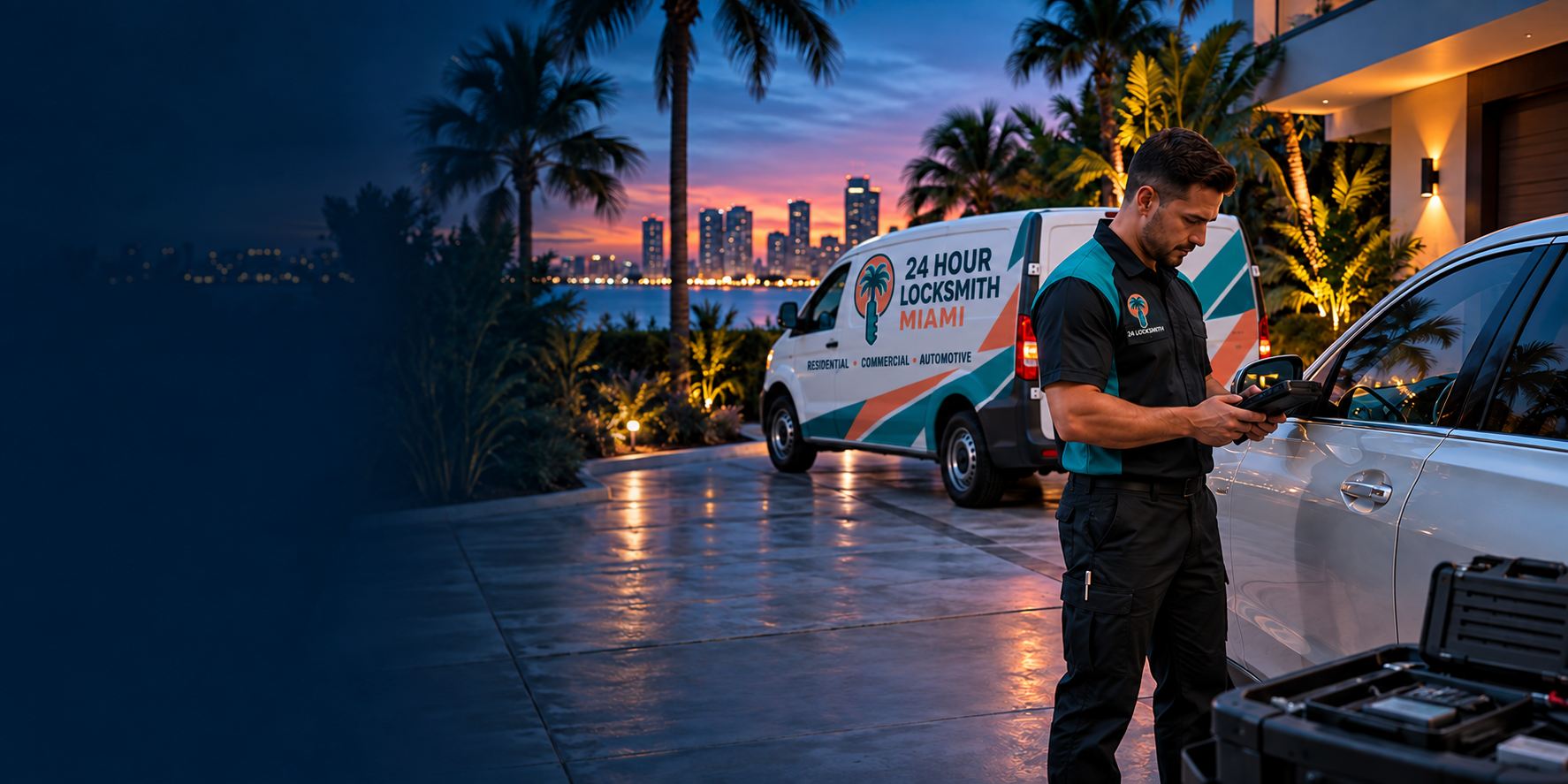
A good arrival follows a pattern. The technician introduces themselves, shows identification and the company name, and confirms the address and the work you asked for. They then ask for your ID and proof of authority, which is normal and a good sign. A vehicle that clearly identifies the company is a plus, though some technicians arrive in plain vehicles. The key point is that the identity matches what you were told on the phone.
Before work starts, the technician should confirm the quote and the service call charge, and explain what will happen. If the job is different from what you described, they should stop, explain what changed, and give you a chance to decide. You are never obliged to proceed. If the explanation does not match the phone call, you can decline, pay only what was clearly explained, and call someone else.
During the work, ask questions. A professional is happy to tell you what they are doing and why. Afterward, test the result: try every key, open and close the door, check the lock from both sides, and confirm that nothing else was damaged. Ask for a receipt that shows the company name and what was done. Our page on how to pay safely for locksmith work and the after the locksmith leaves checklist describe the final steps.
If something goes wrong, the guide on what to do after a bad locksmith experience explains how to respond.
A one-minute summary you can screenshot
If you want a quick version to keep on your phone, here is the checklist in the order you will use it. Everyone safe, or call 911. Move to a safe, lit place. Know your address, the unit or the nearest cross street. Say what you are locked out of and what happened. Describe the lock, door or vehicle. Mention anyone inside or at risk. Give a callback number. Ask the company name, how the quote works, and what the service call charge covers. Have photo ID and proof of address or ownership ready. Do not force anything while you wait. Check identity when the technician arrives, confirm the quote before work begins, and test everything before they leave.
That is the whole routine. It takes less time to follow than to read, and it turns a frightening moment into a manageable one. The details behind each step are in the pages linked above, and they are worth reading calmly before you ever need them, so you are not learning during a lockout.
Some people like to keep a few items ready at all times: a photo of an ID and proof of address stored on a phone, the make, model and year of vehicles in a note, and the key type for each lock at home. If you ever need to call, those details are at your fingertips, and the call is short. For broader planning, our key control for families guide covers spares and who holds them.
When you are ready, call and walk the dispatcher through the situation using this list. They will explain what the visit involves, how the quote works and what to expect, so you can decide with clear information.
Questions people ask
What is the most important thing to tell the dispatcher?
Your exact location and what you are locked out of or what is wrong. After that, mention anyone at risk, such as a child, an elderly person or a pet inside. The dispatcher can then set priorities, ask follow-up questions and tell you whether you should also be calling 911. A callback number matters too.
Why will the locksmith ask for ID?
Opening a door or programming a key gives the person in front of the technician control of the property or vehicle. To protect real owners and occupants, a professional confirms that you have the right to authorize the work. A photo ID plus something tying you to the address or vehicle is the usual standard.
Can I get an exact price over the phone?
Quotes are given by phone, and many standard jobs can be quoted that way. Complicated work, such as a damaged door or a commercial system, may need an on-site visit before a firm quote is possible. The service call charge is explained on the phone before anyone is dispatched, so ask about it directly.
Is it a problem if I tried to open the door myself first?
It is not a problem as long as you say so. Tell the dispatcher what you tried so the technician can choose a method that does not worsen any damage. Hiding it can lead to surprises, since forced locks and bent parts may change the repair. Honesty helps the technician bring the right tools.
What if I cannot find my documents because they are inside?
Think about what you can show from outside. A photo on your phone of a lease, a bill or a registration works for many situations. A driver's license with the matching address may be enough alone. If neither is possible, explain this to the dispatcher, who will tell you what the technician can accept.
Can I decline the work when the technician arrives?
Yes. If the job or the explanation differs from what you were told on the phone, you can decline before work begins. You may still owe the service call charge that was explained before dispatch. Ask the technician to explain any change clearly, and take your time deciding rather than feeling rushed.
Describe the situation by phone and we will tell you what the job involves. Quotes are given by phone. Jobs that cannot be quoted without seeing them need a technician on site, and the service call charge is explained on the phone before anyone is dispatched.
(786) 539-3980Related pages
Written by Claude (AI) (AI) for 24 Hour Locksmith Miami.