
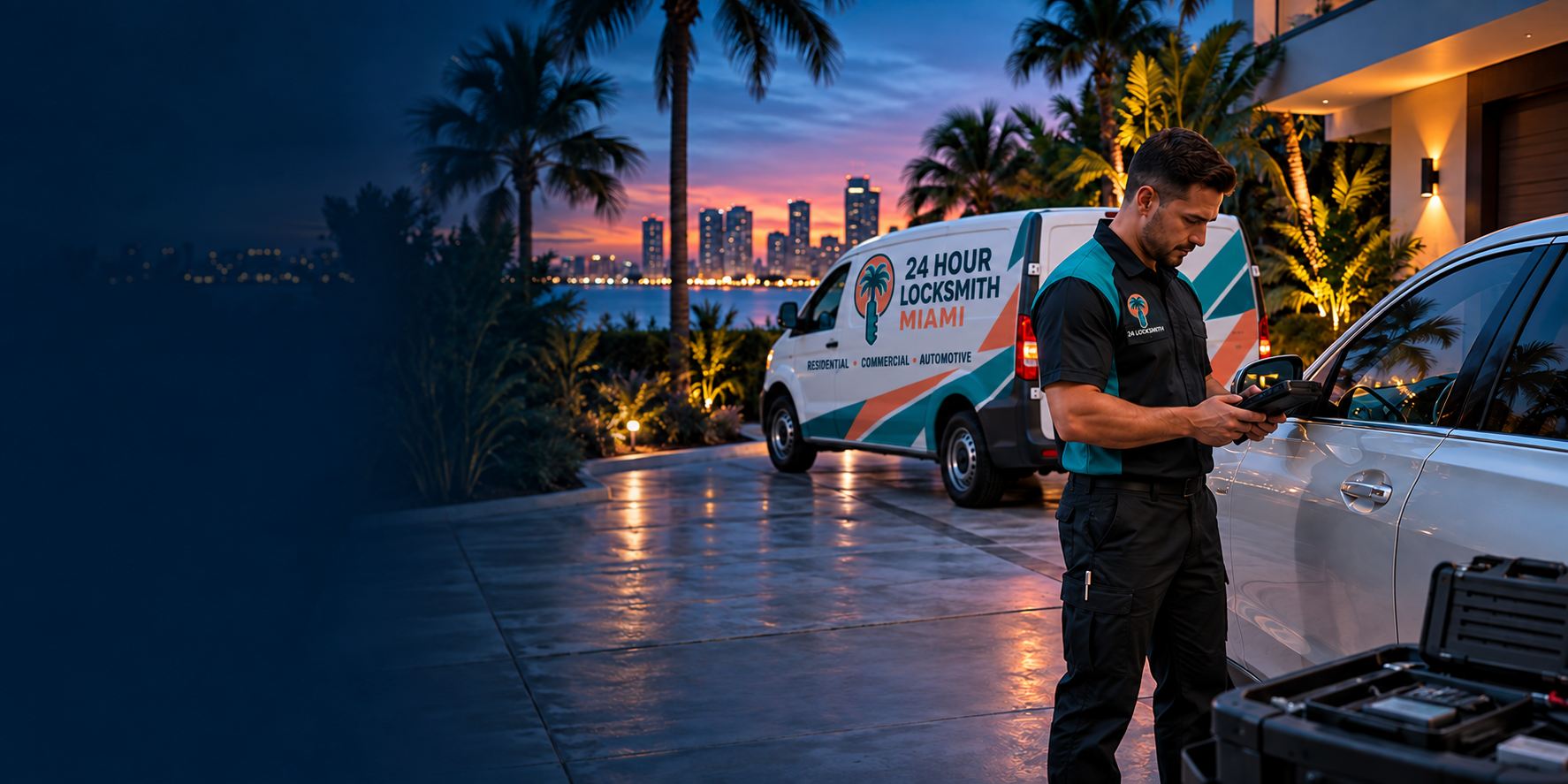
A family of brands with shared key technology
Jeep, Dodge, Chrysler and Ram belong to the same corporate family, and their vehicles share many electronic systems. A Wrangler, a Grand Cherokee, a Charger, a Challenger, a Pacifica and a Town and Country may look nothing alike, but their key systems come from the same lineage. That shared approach helps technicians, who can often apply the same general knowledge across several nameplates.
Miami-Dade has plenty of these vehicles. Jeeps are popular for weekend trips and for the occasional drive along a flooded street. Chargers and Challengers appear in every neighborhood. Minivans carry families to school and to the beach. Each of these vehicles has had owners who lost a key, dropped a fob in the water or discovered at purchase that only one key came with the car.
As with other brands, similar does not mean identical. Different model years use different fob hardware, different blade profiles and different security logic. Treat any assumption about what fits what with caution, and let the vehicle details drive the plan.
The integrated key fob, often called a Fobik
Many vehicles from the mid-2000s onward use an integrated key, sometimes called a Fobik, which combines a remote and a key in one body. It is a small plastic unit with buttons on the face, and a metal blade that is part of the assembly. In many versions, the blade is not removable from the body, and the unit goes into a slot in the dashboard rather than a traditional ignition cylinder.
This design is very common on Jeeps, Dodge trucks and sedans, Chrysler minivans and sedans. Because the electronics and blade form one unit, a damaged blade can mean replacing the whole fob. A cracked body or a worn button panel may sometimes be repaired with a shell, but the transponder and remote circuit remain part of the original key.
Replacement involves cutting the blade to match the vehicle's locks, preparing the transponder and remote electronics and registering them with the car. A technician needs to confirm the correct part for your model year. Several versions exist with different button layouts and different frequencies, and a fob that looks right may be wrong for your car.
Conventional chip keys and flip keys
Older Chrysler-family vehicles use a conventional transponder key with a plastic head and a metal blade. Some of these have a separate remote on the key ring. Others have a remote built into the head. The immobilizer system checks the transponder when you turn the key, and the engine will not run if the chip is wrong.
Some models also use flip keys, in which the blade folds into a remote body. These are more common on certain Chrysler and Dodge models of the past decade. The folding mechanism wears over time, and hinge failures are a frequent reason owners seek a replacement.
As with other makes, a cut blade alone will not start the car. The transponder has to be registered. Some of these systems allow a technician to register keys with authorized access to the vehicle's security module, which requires verification of ownership. Ask the technician to explain what applies to your model year before the work begins.
Push-button systems on newer vehicles
Newer Jeep, Dodge, Chrysler and Ram vehicles use proximity fobs with a push-button start. The car senses the fob in the cabin, allows you to unlock by touching the door handle and permits the engine to start when you press the button. A hidden emergency blade is stored inside the fob, normally used for opening the driver door when the battery has died.
If the battery weakens, the car often provides a backup way to start it by holding the fob against a marked spot on the dashboard, console or steering column. Your owner's manual shows the location. Before assuming you need a new fob, replace the battery and try again.
A lost or damaged proximity fob needs a replacement of the correct type for your model and year, followed by registration with the car. Some vehicles limit the number of fobs that can be stored, and some require all fobs to be present at the time of registration. If you still have working fobs, bring them all, and ask the technician what applies to your vehicle.
The security system and the role of a PIN
The Chrysler family's immobilizer system stores information about each registered key in the vehicle's electronics. To add a key, the technician generally needs to authenticate with the car, and for many models that involves a security PIN that is tied to the vehicle and released through manufacturer-approved channels after verification of the requester. The PIN is not something a technician can invent. It comes from the vehicle's data.
What this means for you is that the process may include a verification step and a short wait while the technician obtains the information needed. A provider who has the right access can usually manage this on site. A provider without it cannot, and you should ask whether they have the necessary access before you agree to a visit.
You may also hear about systems that allow the owner to program additional keys using existing keys and a procedure from the owner's manual. On some models, that is possible. On others, it is not. If the manual describes such a procedure for your model, you may try it carefully, but if you are unsure, a call to a professional can save you from accidentally erasing keys you meant to keep.
When all keys are lost on one of these vehicles
Losing every key is the worst case, but for many Jeep, Dodge and Chrysler vehicles it is manageable. The technician verifies ownership, obtains the information needed from the vehicle and creates a key and registers it. For some models, the work can be done at the car in a driveway or a lot. For others, a more involved procedure is needed, and a few cannot be done outside the manufacturer.
Be ready with the VIN, the model and year and your ownership documents. Tell the technician where the car is, whether it can be reached and whether it is in a location with restrictions, such as a secure garage. If the vehicle has been in an accident, or has had an ignition or module replaced, mention it, because these events can complicate key work.
If the vehicle needs to be moved, ask how. Jeeps with four-wheel drive and vehicles with electronic parking brakes need proper handling, and a wrong tow can cause damage. Our overview of replacing all lost car keys provides further background.
Water, mud and Jeep life
Jeeps and similar vehicles live adventurous lives. Keys go into pockets next to wet swimsuits, onto beach towels, into boats and across muddy trails. A fob that sits in an open cup holder on a top-down drive can pick up salt spray and humidity. An integrated fob does not have the same weather sealing as a rugged tool, and repeated exposure shortens its life.
If your fob gets wet, remove the battery if the case opens, dry the unit in open air and avoid pressing buttons while it is wet. Do not use a hair dryer or place it in an oven, because heat damages the circuit board and can warp the case. Even if the fob seems to work afterward, have it tested, since corrosion can develop slowly.
Consider a small waterproof pouch or case for outings, and keep a spare at home. If you have a vehicle with removable doors or a soft top, remember that your keys and valuables are more exposed when the car is parked. A key left in a cup holder can be visible to anyone passing by. Our page on vehicle theft prevention basics offers habits that help.
Dealer or locksmith for these vehicles
A dealer can order a key for your VIN and register it through the manufacturer's systems, and for some of the newest vehicles that is the only complete route. The common difficulties are practical. The car has to reach the service department, which is hard with no key, and parts may take time to arrive. If the vehicle cannot be driven, a tow adds a step and a cost that depends on distance.
A mobile locksmith with the right access comes to the vehicle. For many Jeep, Dodge and Chrysler models of the past two decades, that works well, including all keys lost situations. The key question for any provider is whether they can access the security PIN and registration process for your exact model. If they cannot, they should say so.
Sometimes the best answer combines both. A locksmith can help with a lockout or a broken key stuck in a lock, and a dealer can handle a restricted function. Our page on dealer versus locksmith car keys compares the two routes in more detail. Whichever you choose, ask what the finished key will do and how many keys will be active afterward.
Everyday situations and how they usually go
A Wrangler owner returns from the beach to find the integrated fob will not respond. The fob got wet and sat in a hot car. The first steps are to let it dry in open air and try a new battery. If the fob still does nothing, a technician can test it, and if it has failed, a new unit is registered to the car. Keeping a spare in a dry place at home prevents the day from turning into a long wait.
A Charger owner buys the car used and receives a single fob. The seller says another one was lost. The safest plan is to add a spare and ask the technician about removing unknown keys from the car's memory. That makes sure only the fobs in the owner's hands can start the car. It also gives a backup in case the single fob fails.
A Pacifica owner with children discovers the fob is locked in the car with the doors closed. If a child is inside, call 911 first. If nobody is inside, our car lockout page explains what a technician can do. Do not try to force a window or a door, as repairs cost more than the lockout service.
A Ram truck owner running a small business has a worker who left, and one of the truck's fobs was never returned. The owner can ask the technician to register new keys and remove the old ones, so that the missing fob no longer works. This is a sensible step whenever keys leave the owner's control, and it ties into the wider practice described in our guide on key control for property owners.
Ownership proof and what to bring
As with any vehicle key, the technician will ask for proof that you may request one. Bring photo identification and a registration or title that connects you to the vehicle. For a financed or leased car, bring whatever paperwork shows you are the authorized driver. For a company vehicle, a letter from the business and your identification usually suffice.
Also have ready the VIN, which is visible at the base of the windshield on the driver's side and on your registration. The technician will ask for the model, year and key type, the number of keys lost and the number remaining. A photo of any surviving key helps them identify the correct part.
Our guides on car key ownership proof and what ID to have ready go into further detail. If something is missing, say so on the call, because it affects what can be done and in what order.
Quotes, charges and honest limits
Prices are not listed on this site. Quotes are given only by phone, after the technician has the details of your vehicle and situation. A service call charge applies to dispatch and is explained before anyone is sent. Complicated jobs may need an on-site visit before a final quote is set, and you will be told in advance.
If your vehicle falls outside what can be done at the roadside, you will hear that on the call. That is better than a technician arriving and being unable to deliver. If the process includes a verification wait, the technician should explain that too, so you can plan your day.
Take care with providers who quote an unusually low figure, who will not give a business name or who propose drilling or replacing parts before attempting anything else. Our locksmith scam warning signs guide lists more red flags. Comparing providers is reasonable, and a good one will not mind it.
Practical habits and next steps
Keep a spare key at home in a dry place, and test it from time to time. Replace fob batteries before they die. Avoid hanging heavy rings from an ignition slot, since weight and movement wear the mechanism. If a flip key or integrated key hinge starts to loosen, have it addressed before it breaks.
If you drive a business vehicle, such as a Ram truck or a Dodge van, think about a written record of who holds which key and a second spare in a safe place. Our guide on fleet key management offers ideas for small fleets.
When you are ready to replace a key, or to add a spare before trouble arrives, call and describe your Jeep, Dodge or Chrysler. A real person will ask for the details that matter, explain what applies to your model and tell you plainly what to expect, including any limits.
Questions people ask
What is a Fobik and can it be replaced?
A Fobik is the integrated key fob used on many Chrysler-family vehicles, with the remote and blade in one unit. It can be replaced by cutting the blade, preparing the electronics and registering the new unit with the car. The correct part depends on the model and year, so give those details on the phone.
Why does my vehicle need a PIN for a new key?
Many Chrysler-family vehicles require a security PIN tied to the vehicle's data before a new key is registered. It is obtained through approved channels after ownership is verified. It protects owners from unauthorized keys. Ask the provider whether they have the access to handle this before you agree to a visit.
My fob got wet at the beach. Should I use it?
Dry it before pressing buttons. Open the case and remove the battery if you can, let it air dry and avoid heat sources. Even if it works afterward, have it tested, because corrosion can develop slowly. A spare kept at home gives you a safety net while you wait.
Can I program my own spare key?
Some older models describe an owner procedure in the manual, usually requiring existing keys. Many newer models do not allow it. If you are unsure which applies, a call to a professional can prevent you from erasing keys by mistake. A technician can tell you what is possible on your vehicle.
How are prices given?
Quotes are given only by phone, after you describe the vehicle and situation. A service call charge applies to dispatch and is explained before anyone is sent. Complicated jobs may need an on-site visit before a final quote, and you will be told about that in advance.
Describe the situation by phone and we will tell you what the job involves. Quotes are given by phone. Jobs that cannot be quoted without seeing them need a technician on site, and the service call charge is explained on the phone before anyone is dispatched.
(786) 539-3980Related pages
Written by Claude (AI) (AI) for 24 Hour Locksmith Miami.