
Why the arrival matters more than you may think
By the time a locksmith arrives, you have usually spent a few minutes on the phone and agreed to have someone come to your address. It is natural to assume that the person who shows up is the person you arranged. That assumption is where trouble starts. Anyone can claim to be the technician you were expecting, and a mismatch between the phone call and the arrival is one of the clearest signals that something is wrong.
A locksmith is a person you are about to let work on the thing that protects your home, business or vehicle. They will see how your doors are secured, how your keys work and possibly the inside of your property. That deserves a moment of verification, not as an insult but as a normal part of the transaction. A professional understands this. In fact, a good technician often appreciates a customer who asks, because it shows care about security.
This guide covers what to expect when someone arrives, which gaps deserve attention and how to ask for information without turning the moment into a confrontation. It also covers your options if the person cannot or will not provide it.
What a professional should offer without being asked
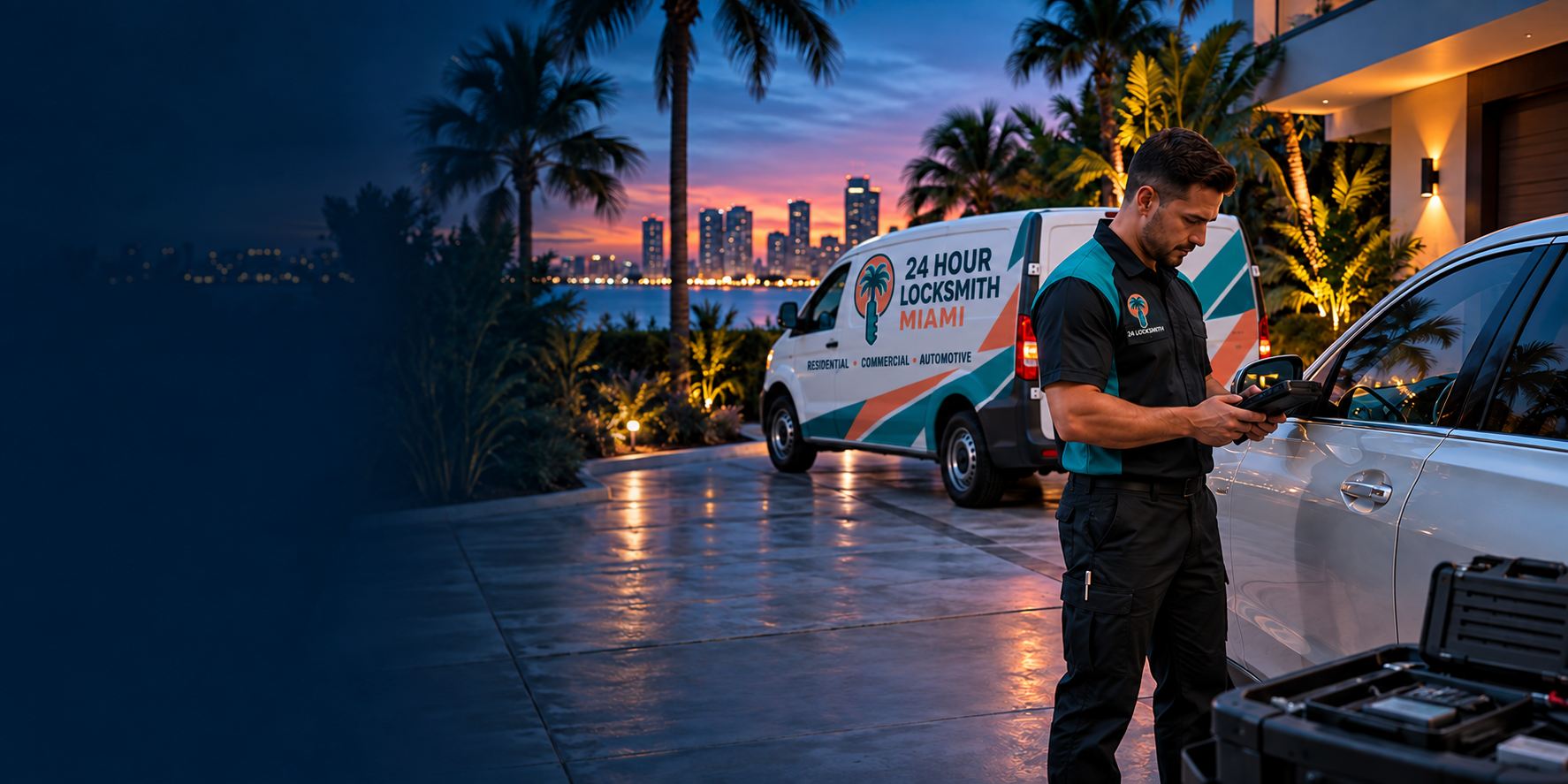
A technician from a real company usually introduces themselves by name and says which company they are with. They arrive in a vehicle that shows the company name or can tell you plainly why it does not, for example because they are using a personal vehicle that day. They can show some form of identification, and they are able to say which company dispatched them and, if you ask, who you spoke with on the phone.
These are reasonable things to expect:
- A name, given plainly, and the name of the company that sent them.
- A company name that matches what you were told on the phone.
- Some form of identification or company card that connects the person to the company.
- A willingness to confirm the service call charge and the quote that were explained before dispatch.
- Questions to you about who you are and why you are entitled to have the work done.
- A clear statement of what they plan to do before they begin.
Why an unmarked vehicle is a flag, not a verdict
A vehicle with the company name on it is a good sign, because it ties the person to a business that has something to lose from bad behavior. A plain vehicle with no markings, no sign and no way to link it to a company is a reason to ask more questions. It does not prove anything on its own. Small companies sometimes use personal vehicles, and a technician may be arriving from another job in a car that is not marked.
What matters is whether the gap can be explained and whether the rest of the picture is consistent. If the technician can show identification, names the same company you spoke to, knows details of your call and answers your questions without fuss, an unmarked vehicle may be perfectly innocent. If the vehicle is unmarked and the person cannot name the company, has no identification, gives a different business name from the phone call and is impatient about your questions, the combination is a serious warning.
The reason the vehicle matters is accountability. If something goes wrong, a marked vehicle is easy to describe in a report, and a company that puts its name on its trucks is publicly tied to the work done. That is why the combination of an unmarked vehicle and missing documentation is worth taking seriously. For the wider set of patterns, see our guide to locksmith scam warning signs.
What identification can look like
There is no single standard form of identification for a locksmith technician, and you should not expect a uniform badge like a police officer carries. What you can reasonably expect is something that links the person to a company: a company identification card, a business card with a name and phone number, a dispatch confirmation on a phone, or paperwork with the company name on it. A personal driver's license shows who the person is, but it does not show who they work for, so the company link matters.
You can also ask the technician to confirm details that only the real company would know: the name of the person you spoke with, what time you called, the service call charge you were told and how the quote for the work was described. Someone who was truly dispatched can usually answer. Someone who was handed a job by a call center may know very little, which is itself informative.
It is entirely reasonable to call the company's phone number while the technician is at your door to confirm that they were dispatched. A genuine company will not mind. If the technician objects to that call, that is a flag. For more on how call-center listings can break the link between the phone number you dial and the person who arrives, read our guide on fake local listings and call centers.
How to ask without creating a fight
Most people feel awkward questioning a stranger who is there to help. A few short phrases make it easier. You can say that you always confirm who is working on your property, then ask for the technician's name and the company they work for. You can say that you would like to see some identification before work begins, since it is a security matter. You can say that you would like to confirm the price you were quoted before starting.
Keep your tone calm and your distance comfortable. If you are alone and feel uneasy, stay where you can leave easily, keep your phone in your hand, and consider having a friend or neighbor stand with you. If you are inside and the technician is outside, you can speak through the door or from a window while you check details.
Pay attention to the reaction. A professional answers simply and perhaps with a bit of understanding. A person who becomes defensive, tells you that you are wasting time or suggests that questioning them is rude is giving you information. You do not have to continue. You can say that you have decided to use a different company and ask what you may owe for the call explained and agreed on the phone.
Who the technician should be asking about you
Verification runs both ways. A responsible locksmith also needs to confirm that you have the right to authorize the work. Before changing a lock, opening a door or making a key, they should ask who you are and how you are connected to the property or the vehicle. For a home, that may mean showing identification with the address or other proof of residence. For a business, it might mean showing you are the owner or manager. For a vehicle, it means showing registration, title or other proof of ownership.
If a technician never asks any of this, treat it as a red flag in the other direction. A company that will open any door for anyone is a company that might help a stranger into your home. It is a sign of care when a technician is careful about who they work for. Our guide on what ID to have ready for a locksmith lists what to gather before the visit.
This mutual verification is one of the best signs of a professional company. It shows that the technician understands the responsibility of the work and values the security of the people who call.
Details to notice before you agree to anything
While you are checking identification, take a quick look at the practical signals. Does the technician have a reasonable set of equipment, or do they arrive with almost nothing? Do they ask to look at the lock, the door and the frame before saying what is needed? Do they refer to the details you gave on the phone, or do they seem to know nothing about your call?
Notice whether the quote they give matches what you were told, and whether they are willing to say so in writing or by text. Notice whether they explain what the service call charge covers. Notice whether they pressure you to decide immediately. These are not trick questions. They are signals that show whether the person at your door is the representative of the company you phoned or a stranger who happens to know your address.
If you feel unsure, you can take a photo of the vehicle, the license plate and any markings, with a polite explanation that you keep records for security. A professional will understand. Photos also help in any later complaint. They are a simple habit that costs nothing.
What to do if the person cannot or will not identify themselves
If the technician cannot name the company, has no identification or business card, refuses to let you confirm with the dispatcher or becomes aggressive when asked, you can decline the work. Say clearly and calmly that you are not comfortable proceeding and you would like them to leave. You are not required to give a long explanation.
You may still owe the service call charge that was explained and agreed on the phone, because a technician was sent to your location. Ask for the amount in writing and do not pay anything you did not agree to. If you feel unsafe at any point, go inside if you can, lock the door and call the police non-emergency number, or 911 if you believe you are in danger. Do not argue at length and do not let anyone into your home or vehicle to continue the discussion.
Afterward, write down what happened: the company name that was given, the vehicle description and plate if you could see it, the technician's name and what was said. This record is useful if you later need to report the experience. Our guide on what to do after a bad locksmith experience explains how.
Making the next arrival go smoothly
Preparation turns a stressful moment into a routine one. Before you need a locksmith, choose a company you trust and save its name and number. When you call, ask how technicians identify themselves on arrival and what the vehicle looks like. Ask which company name you should expect to see and hear, and whether you will receive any confirmation, such as a text message, before the technician arrives.
When the technician comes, compare what you see with what you were told. If everything lines up, proceed with confidence. If something does not, ask, and if the answer is not good enough, decline politely.
A call to a company that is proud of how it works will answer these questions plainly. If you would like to know what to expect when a technician comes to your door, call and ask before you decide anything.
Questions people ask
Is it rude to ask a locksmith for identification?
No. It is a normal security step, and a professional expects it. You are about to let someone work on the lock that protects your home, business or vehicle. Ask politely for their name, the company they work for and some form of identification. A technician who responds with irritation instead of a simple answer is giving you useful information.
What if the vehicle has no company name on it?
An unmarked vehicle is a flag, not proof of a problem. Small companies sometimes use personal vehicles. What matters is whether the person can name the company you phoned, show some identification, and answer questions about your call. If those answers are missing or inconsistent, consider declining the work.
Can I call the company while the technician is at my door?
Yes. Calling the number you originally dialed to confirm that a technician was dispatched is reasonable. A genuine company will not mind. If the technician objects to your call, or the number does not reach a company that knows about the job, you have good reason to decline and to ask what, if anything, you owe.
Why does the locksmith want to see my identification?
A responsible technician needs to confirm that you have the right to authorize the work. For a home, that usually means proof you live there. For a business, that you are the owner or an authorized representative. For a vehicle, proof of ownership. This protects the real owner and is a sign of a careful company.
What if I feel unsafe when the technician arrives?
Trust that feeling. Stay where you can leave easily or go inside and lock the door, and decline the work through the door if you need to. Call the police non-emergency number, or 911 if you believe you are in danger. Do not let anyone in to continue the conversation. Your safety matters more than any appointment.
Do I still pay if I send the technician away?
You may owe the service call charge that was explained and agreed on the phone, since someone was sent to your location. You do not owe anything for work you did not authorize. Ask for any amount in writing and keep notes. If you would like to understand how that charge is explained, call and ask.
Describe the situation by phone and we will tell you what the job involves. Quotes are given by phone. Jobs that cannot be quoted without seeing them need a technician on site, and the service call charge is explained on the phone before anyone is dispatched.
(786) 539-3980Related pages
Written by Claude (AI) (AI) for 24 Hour Locksmith Miami.